

Technology


Wheel Loader
Automated Operation
Supported Models (Based on Past Projects)
Komatsu
- WA100
Please consult us for models not listed.
Control Methods / Equipment
Autonomous operation is enabled by installing and controlling actuators and motors on the steering, foot pedals, and joysticks. Additionally, depending on the machinery, some components like joysticks (forward/reverse, lift arm, bucket) and steering can be controlled via electrical signals; in such cases, we intervene through electronic circuits.
Installed Equipment
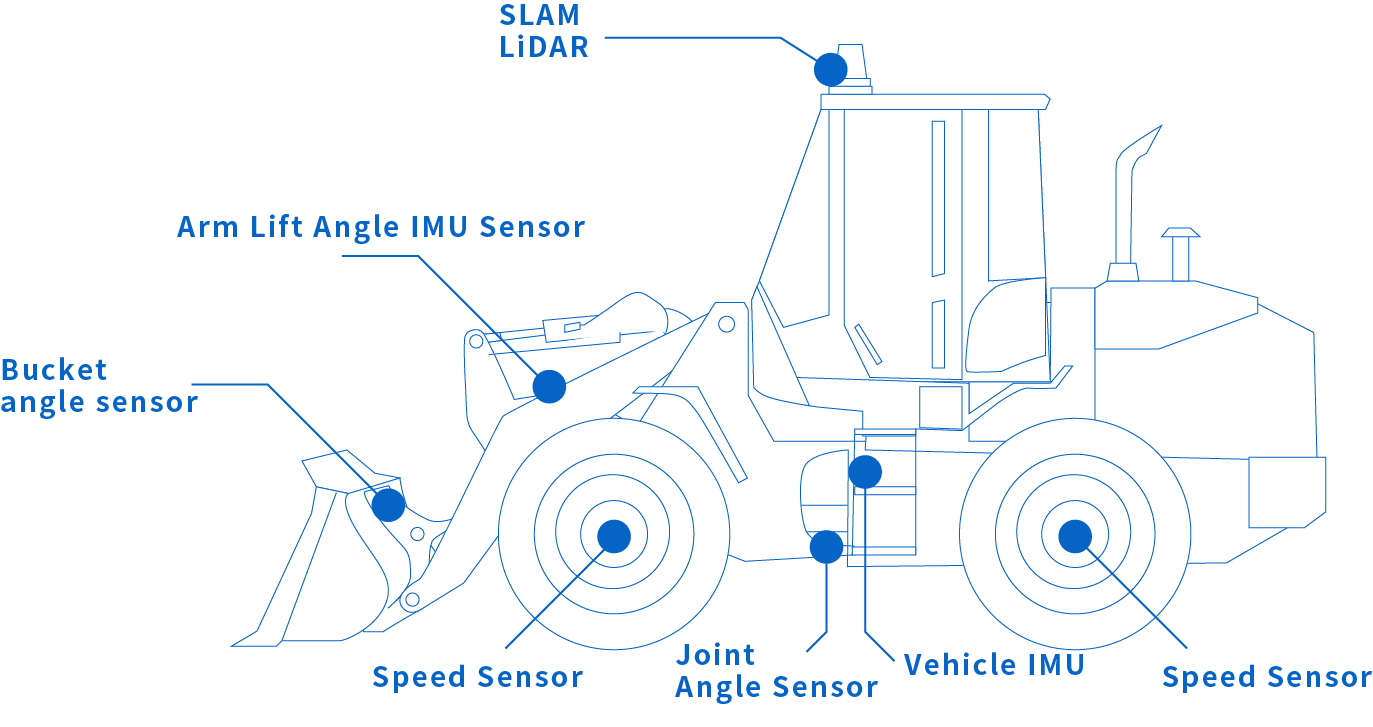
We install actuators/motors for each operation system, an autonomous operation control computer, and a portable battery inside the cabin; on the exterior, we install various sensing devices (LiDAR, vehicle speed sensor, articulate angle sensor, etc.), an emergency stop antenna, a warning light, and a communication antenna.
Supported Operations
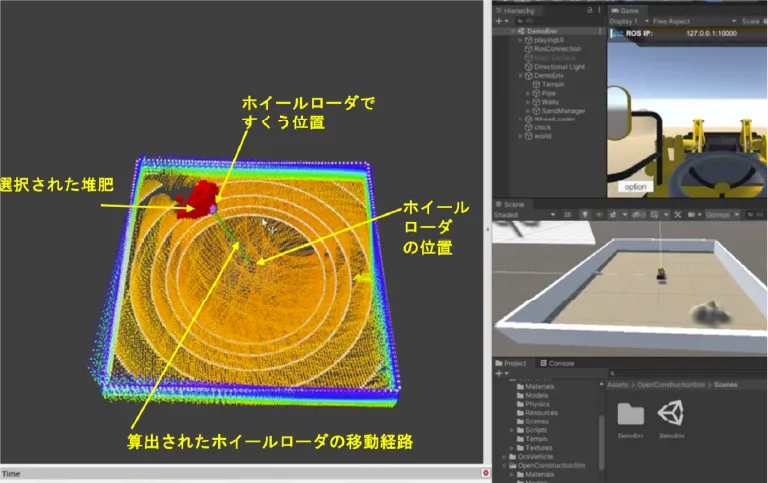
Environment Detection: Self-position measurement, ground surface measurement, excavation position detection.
Machinery Control: Specified route tracking, forward/reverse, automatic scooping/lowering movement, global route planning, Kalman control.
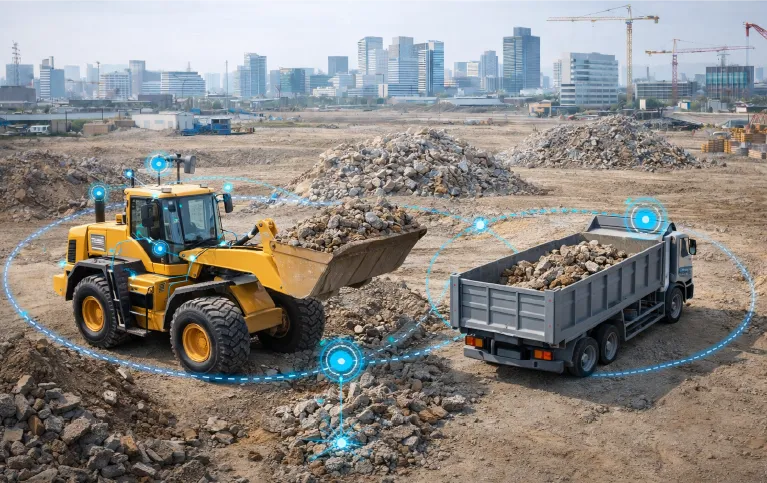
The use case is the autonomous driving of wheel loaders for repetitive tasks used in transporting compost or materials within plants.
*When providing autonomous solutions, we will make proposals suited to the customer's environment based on interviews, site visits, and machinery inspections.
*Requires on-site safety management by customer.
Features
- We support the implementation of Teleoperation for multiple machines on-site through retrofit and multi-manufacturer compatibility.
- Teleoperation functions are implemented via retrofitting without modifying the machinery. *Please check with the manufacturer regarding the impact on periodic voluntary inspections.
- For both MODEL E and V, switching between remote and manned cabin operation is possible simply by toggling a control switch, with no need to remove installed equipment.
- From a safety design perspective, an emergency stop device is provided to immediately stop remote operations in an emergency. The system is also designed to stop Teleoperation if it goes out of the emergency stop device's communication range.
Activation Method / Trigger
Routes are pre-specified via tablet or PC operation. Instructions for work, operation start, and stop can be sent remotely using a tablet, PC, or switch. Emergency stops are also possible via the emergency stop device.
Network (Distance)
Operation over ultra-long distances is possible if the communication environment is established.
| Connection distance | Video Latency | Command Latency | |
|---|---|---|---|
| Ver. Long Range | 1,141km | 338ms | 115ms |
| Ver. Short Range | 100km | 261ms | 87ms |
*Results may vary depending on communication environment
FAQ
Can the installed equipment be transferred to another machine?
Transfer is technically possible if the model, part number, and year are the same, but adjustments to the mounting equipment will be required.
Also, labor costs for removal and re-installation will be incurred.
What kind of network environment is required? Is 5G, Wi-Fi, or another special network needed?
We can support any environment. We implement using the optimal communication environment suited to the site, such as 4G/5G/LTE lines, fiber optics, dedicated communication environments, Wi-Fi, or satellite links.
Are there issues with environmental conditions like heat or cold?
Depending on the environment, special measures for cameras and various devices may be required (e.g., heat-resistant or cold-resistant processing).
Can the customer remove the equipment themselves?
We do not recommend removal by the customer, as specialized knowledge is required for disconnecting wiring and control computers.
How long does installation and removal take?
Our technical team can perform either installation or removal in approximately one business day per unit. Construction may take longer than expected in special environments.
What cannot be handled by autonomous operation?
Currently, flexible autonomous driving or tasks that require human-like decision-making cannot be performed.
If autonomous operation is introduced, is manned operation still possible? Does it also include Teleoperation?
Manned operation is possible even when the autonomous system is installed by switching modes.
Also, depending on requests, it is possible to provide a Teleoperation system and operator seat in addition to autonomous operation.
Regarding safety measures, are emergency stops and obstacle avoidance possible?
Emergency stops are possible via an emergency stop device. Stops can also be initiated by operating terminals such as PCs or tablets.
Obstacle avoidance is possible by implementing obstacle detection and avoidance functions within the autonomous driving features.
*Operation of heavy machinery involves inherent risks.
ARAV's systems are assistive technologies and do not replace the customer's responsibility for site safety management and legal compliance.
